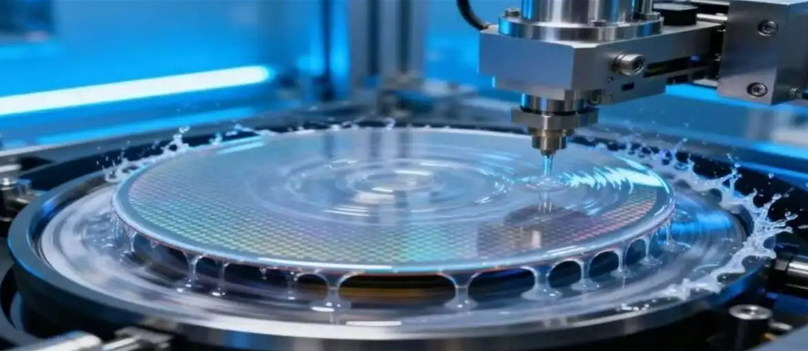
Watch the 300 mm wafer roll into the lithography cell. Spin on the photoresist, and the clock starts ticking. You need a soft bake that pulls out solvent without making the resist flow. You need a hard bake that crosslinks the resist without inducing slip or stress. And you need both—consistently—so the process survives lot after lot of qualification.
Als de wafer van 300 mm de lithografiecel binnenkomt, wordt de fotoresist aangebracht en begint de tijd te lopen. Er is een soft bake nodig die het oplosmiddel verwijdert zonder dat de resist vloeit. Daarnaast is een hard bake vereist die de resist crosslinkt zonder slip of spanningen te veroorzaken. Beide processen moeten consistent zijn, zodat de procedure loth na lot kwalificaties doorstaat.
If the bake isn’t uniform, you’ll see linewidth variation across the field. Ramp too slow, and you burn thermal budget and drift your critical dimensions. Let the heater drift, and your calibration ages until your control charts stop telling the truth. In quantum dot (QD) fabrication, the stacks are thin, the interfaces are sharp, and the thermal window is tight. One bad bake can wipe out margin the device team fought hard to design in.
Als de bake niet uniform is, ontstaan variaties in de lijndikte over het veld. Een te langzame temperatuurstijging verbruikt onnodig thermisch budget en veroorzaakt afwijkingen in de kritische afmetingen. Laat de verwarming afwijken, dan veroudert de kalibratie totdat de control charts geen betrouwbare gegevens meer geven. Bij quantum dot (QD) fabricage zijn de lagen dun, de interfaces scherp en het thermische venster krap. Eén slechte bake kan de marges, waar het apparaatteam hard voor heeft gewerkt, tenietdoen.
That’s why we built our QD fabrication heaters around infrared (IR) heating. Semiconductor thermal work isn’t just about hitting a temperature—it’s about delivering temperature to the film, uniformly, with a rise and settle you can count on.
Daarom zijn onze QD-fabricageverwarmers gebaseerd op infrarood (IR) verwarming. Thermisch werk in halfgeleiderfabricage draait niet alleen om het bereiken van een temperatuur, maar vooral om het uniform leveren van temperatuur aan de film, met een betrouwbare op- en afbouw.
What matters under the hood
IR heating in wafer processing isn’t a heat gun pointed at a surface. It’s a controlled flux profile matched to the substrate and the film stack.
IR-verwarming bij waferverwerking is geen hete luchtpistool gericht op een oppervlak. Het betreft een gecontroleerd fluxprofiel dat is afgestemd op het substraat en de filmlaag.
We use short-wave IR sources with a fast response, so you get rapid, repeatable ramps without overshoot. The emitters are arranged to give uniform power across the wafer plane, and the system measures temperature at multiple points to close the loop. The payoff is wafer-level uniformity of ±0.1°C across the full process window.
We gebruiken kortgolvige IR-bronnen met een snelle respons, zodat er snelle, reproduceerbare temperatuurstijgingen zijn zonder overshoot. De emitters zijn zo geplaatst dat ze een uniforme vermogensverdeling over het wafervlak bieden, en het systeem meet de temperatuur op meerdere punten om de regeling te sluiten. Dit resulteert in een uniformiteit op wafer-niveau van ±0,1°C over het volledige procesvenster.
That number isn’t a slogan. It means when your photoresist soft bake runs 90–110°C, the center and edge see the same setpoint within tolerance. It means when your hard bake runs 100–130°C, you’re not chasing hot spots by trimming recipes. Uniformity translates straight into linewidth control and defect performance.
Dit getal is geen marketingterm. Het betekent dat bij een soft bake van de fotoresist tussen 90–110°C het midden en de rand van de wafer binnen dezelfde toleranties dezelfde ingestelde temperatuur zien. Bij een hard bake van 100–130°C betekent het dat er geen hot spots achtervolgd hoeven te worden door receptaanpassingen. Uniformiteit vertaalt zich direct in lijndiktecontrole en defectprestaties.
The heater is built for cleanroom reality. It runs in Class 1–100 environments without triggering particle excursions, because the hot zone is isolated from the mechanical envelope, and the exhaust path prevents outgassing carryover. The hot-zone materials are chosen to minimize particle shedding during thermal cycling.
De verwarming is ontworpen voor cleanroomomstandigheden. Het werkt in Class 1–100 omgevingen zonder dat er deeltjesuitschieters optreden, omdat de hete zone geïsoleerd is van de mechanische behuizing en de afzuigroute outgassing overdracht voorkomt. De materialen in de hete zone zijn geselecteerd om deeltjesafgifte tijdens thermische cycli te minimaliseren.
Reliability comes down to uptime and stability. Our units run 24/7 in production with zero unplanned downtime, and emitter life is rated beyond 5,000 hours with less than 5% output drift. That matters because every tool change is a qualification, and every qualification costs time and capacity.
Betrouwbaarheid hangt af van beschikbaarheid en stabiliteit. Onze units draaien 24/7 in productie zonder ongeplande stilstand, en de levensduur van de emitters wordt geschat op meer dan 5.000 uur met minder dan 5% output-drift. Dit is belangrijk omdat elke gereedschapswissel een nieuwe kwalificatie vereist, en elke kwalificatie kost tijd en capaciteit.
The control system keeps repeatability tight. Temperature repeatability holds within ±0.5°C bake to bake, and ramp control stays within 1% across cycles. For wafer drying and post-clean bake steps, the same platform gives you controlled desorption without thermal shock. The profile is reproducible—and reproducibility is what makes control charts worth looking at.
Het regelsysteem zorgt voor strakke reproduceerbaarheid. De temperatuurvariatie tussen bakes blijft binnen ±0,5°C, en de regeling van de temperatuurstijging blijft binnen 1% over meerdere cycli. Voor waferdrogen en post-clean bakes biedt hetzelfde platform gecontroleerde desorptie zonder thermische schokken. Het profiel is reproduceerbaar, en die reproduceerbaarheid is essentieel voor betrouwbare control charts.
Why this works for QD lines
Quantum dot fabrication is all about thin films, patterning, and interface control. The thermal steps aren’t auxiliary—they set the stage for everything that follows.
Quantum dot fabricage draait om dunne films, patroonvorming en interfacecontrole. De thermische stappen zijn niet bijzaak, ze bepalen de basis voor alles wat volgt.
In photoresist processing, the soft bake is your first real control point. Too little energy, and solvent remains, giving you footing and scum. Too much, and the resist flows, killing resolution. Our IR heater dries the resist quickly and evenly, with a controlled plateau that removes solvent without pushing the resist past its flow point.
Bij verwerking van fotoresist is de soft bake het eerste echte controlepunt. Te weinig energie betekent dat oplosmiddel achterblijft, wat leidt tot hechting en residu. Te veel energie zorgt ervoor dat de resist vloeit, wat de resolutie vermindert. Onze IR-verwarmer droogt de resist snel en gelijkmatig met een gecontroleerd plateau, dat het oplosmiddel verwijdert zonder de resist voorbij het vloeipunt te brengen.
Then comes the hard bake, where the goal is crosslinking without stress. Nonuniform heating creates thermal gradients, and those gradients become stress gradients across the wafer. You end up with pattern slip, edge bead issues, and yield loss on the edge die. With ±0.1°C uniformity, the crosslink profile stays consistent across the wafer, and edge yield settles down.
Vervolgens is er de hard bake, waarbij het doel is crosslinking zonder spanningen. Niet-uniforme verwarming veroorzaakt thermische gradiënten, die overgaan in spanningsgradiënten over de wafer. Dit leidt tot patroonverschuivingen, edge bead-problemen en uitval aan de rand. Met een uniformiteit van ±0,1°C blijft het crosslinkprofiel consistent over de wafer en stabiliseert het rendement aan de rand.
Wafer drying and post-clean bakes are just as touchy. A wet wafer entering the coat track can carry micro-droplets that leave marks after spin. A post-clean bake that’s too aggressive can pull moisture out too fast and drag particles back onto the surface. The IR platform gives you a rapid, controlled bake that brings the wafer to a stable state without thermal shock, keeping particle count low and surface energy consistent.
Waferdrogen en post-clean bakes zijn even gevoelig. Een natte wafer die de coat track ingaat kan microdruppels meenemen die na spinvloeien vlekken achterlaten. Een te agressieve post-clean bake kan vocht te snel onttrekken en deeltjes terug op het oppervlak brengen. Het IR-platform biedt een snelle, gecontroleerde bake die de wafer naar een stabiele toestand brengt zonder thermische schokken, waardoor het aantal deeltjes laag blijft en de oppervlakte-energie constant.
The gains are measurable. Tighter uniformity narrows linewidth distribution, which cuts trim budgets and mask iterations. Repeatable ramps reduce thermal load on underlying layers, preserving doping profiles and interface quality. Stable cycles cut scrap and rework—fewer rework cycles means higher throughput without adding capital.
De verbeteringen zijn meetbaar. Strakkere uniformiteit verkleint de spreiding in lijndikte, wat trim-budgetten en maskeraanpassingen vermindert. Reproduceerbare temperatuurstijgingen verlagen de thermische belasting van onderliggende lagen, waarmee dopingprofielen en interfacekwaliteit behouden blijven. Stabiele cycli verminderen afval en nabewerking; minder nabewerking betekent een hogere doorvoer zonder extra investeringen.
Energy use drops, too. IR heats the wafer and film stack directly, with minimal chamber heating. Setpoint is reached fast, and hold is steady without wide cycling. That lowers kWh per lot, and in high-volume fabs, that savings adds up fast.
Ook het energieverbruik neemt af. IR verwarmt de wafer en filmlaag direct, met minimale verhitting van de kamer. De ingestelde temperatuur wordt snel bereikt en stabiel gehouden zonder grote cycli. Dit verlaagt het aantal kWh per lot, en in high-volume fabs lopen deze besparingen snel op.
The practical details you’ll run into
An IR heater isn’t a drop-in swap for every thermal module. It needs line-of-sight to the wafer, and the mechanical envelope has to keep the hot zone from coupling heat into adjacent components. If space is tight, the integration plan has to cover emitter placement, shielding, and exhaust routing.
Een IR-verwarmer is niet zomaar een directe vervanging voor elk thermisch module. Er is zichtlijn nodig naar de wafer, en de mechanische behuizing moet voorkomen dat warmte vanuit de hete zone wordt overgedragen naar aangrenzende componenten. Bij beperkte ruimte moet het integratieplan de plaatsing van emitters, afscherming en afzuigroutes omvatten.
Thermal mass matters. If you’re used to a high-thermal-mass hot plate, your process window may have been tuned around slow ramps. IR has lower thermal mass and faster response, which can expose timing mismatches in the recipe. Plan a re-qualification that captures ramp rate, soak time, and temperature settle—not just peak temperature.
Thermische massa is belangrijk. Als u gewend bent aan een warmplaat met hoge thermische massa, is het procesvenster mogelijk afgestemd op langzame opwarmingen. IR heeft een lagere thermische massa en een snellere respons, wat timingmismatches in het recept kan blootleggen. Plan een herkwalificatie die de opwarmingssnelheid, inwerktijd en temperatuurstabilisatie vastlegt, niet alleen de piektemperatuur.
Film stacks can be absorptivity-sensitive. Different underlayers absorb IR differently, which can shift the effective temperature profile. We run absorptivity mapping across common stacks during installation, and the control system stores compensation profiles so the same setpoint delivers the same film temperature across product variants.
Filmlagen kunnen gevoelig zijn voor absorptie. Verschillende onderlagen absorberen IR-straling verschillend, wat het effectieve temperatuurprofiel kan verschuiven. Tijdens de installatie voeren we absorptiemetingen uit over gangbare stacks, en het regelsysteem slaat compensatieprofielen op zodat dezelfde ingestelde temperatuur bij verschillende productvarianten dezelfde filmlaagtemperatuur oplevert.
Cleanroom compatibility is straightforward, but it isn’t automatic. The heater has to be plumbed to the right exhaust, and the exhaust must be balanced so you don’t get backflow when the door opens. Particle performance depends on airflow discipline. We provide cleanroom interface drawings and exhaust load calculations, and we verify particle counts during commissioning.
Compatibiliteit met cleanrooms is eenvoudig, maar niet vanzelfsprekend. De verwarming moet worden aangesloten op de juiste afzuiging, en de afzuiging moet zodanig gebalanceerd zijn dat er geen terugstroming optreedt bij het openen van de deur. Deeltjesprestaties hangen af van goede luchtstroomdiscipline. Wij leveren cleanroom interface-tekeningen en berekeningen van afzuigbelasting, en controleren de deeltjesaantallen tijdens inbedrijfstelling.
If you’re running quantum dot fabrication at pilot or volume, thermal steps are where wins and losses happen quietly. The bake isn’t a background step—it’s a control lever.
Bij quantum dot fabricage, zowel pilot als volume, bepalen de thermische stappen stilzwijgend het succes. De bake is geen achtergrondstap, maar een regelhendel.
We deliver an IR heater that makes that lever precise, stable, and repeatable. You get a soft bake that removes solvent without flow, a hard bake that crosslinks without stress, and drying that leaves the wafer ready for the next coat. You get uniformity you can measure, repeatability you can qualify, and uptime you can bank on.
Wij leveren een IR-verwarmer die deze regelhendel nauwkeurig, stabiel en reproduceerbaar maakt. U krijgt een soft bake die oplosmiddel verwijdert zonder vloeien, een hard bake die crosslinkt zonder spanningen, en een droogproces dat de wafer klaarmaakt voor de volgende laag. Uniformiteit is meetbaar, reproduceerbaarheid kwalificeerbaar en beschikbaarheid betrouwbaar.
When the wafer moves into the lithography cell, the bake shouldn’t be what you’re thinking about. It should just work.
Wanneer de wafer de lithografiecel ingaat, hoeft u niet aan de bake te denken. Het moet gewoon werken.